Departments

City Assessing

CITY ASSESSING SITE ←

ALL ASSESSING FORMS ←

Assessor

Contact

Michigan Assessing Coalition, LLC

assessor@beavertonmi.org

(517) 940-2823

https://macinc-group.org/

Oversees

  • Taxable property values
  • Records of ownership, addresses, tax exemptions, sales, and land and building details

Office Hours

Office Hours are held on the first and third Tuesday of each month. Appointments are recommended and given priority.

Schedule an appointment by email assessor@beavertonmi.org or call City Hall at (989) 435-3511 ext 1

How Do I…

Whenever real estate or some types of personal property are transferred (even if you are not recording a deed), a Property Transfer Affidavit must be filed to the Assessor by the new owner within 45 days of the transfer. The affidavit is used to make sure that property is assessed properly and receives the correct taxable value.

What Is It?

An Assessment Appeal, also called a Property Tax Reduction Appeal, is a request to lower the assessed value of a property.

Do I Qualify?

Per State law, the sale price of a property cannot be the sole determining factor of the assessment of that property. Neither the Assessor nor the Board of Review can raise or lower a property’s assessment based solely on its sales price.

All assessments are partially based on the sales of similar properties during a particular time frame. For example, the time frame for 2019 assessments is taken from home sales that occurred between April 2016 through March 2018. These sales are “arms-length transactions” meaning we do not typically use bank sales, foreclosures, etc. since they generally do not represent a sale between a willing buyer and a willing seller. Sales information is available on this website or in the Assessor’s office. You may also contact a local realtor.

You may receive a Board of Review reduction in your assessment if:

  • Properties in your neighborhood, similar to yours in size, style, and age, recently sold on the open market for significantly less than double your assessed value.
  • You present a recent appraisal from a licensed and certified appraiser showing that the value of your property is significantly lower than the City’s assessed market value
  • Your property was recently purchased on the open market with a Realtor at a price lower than double the State Equalized Value (SEV). You must present a copy of the listing agreement.
  • Your building suffered severe structural damage such as settlement causing severe cracking, water damage so extensive as to undermine the foundation or fire damage. In these instances, you can request an inspection for the property for a reduction in your assessment in relation to the damage.

Lower assessments are not granted from the Board of Review because:

  • Your property needs paint, carpet, windows, etc. You are expected to maintain your property in a reasonable condition. Assessments will not be lowered because you fail to do so.
  • Neighbors have too many cars in the drive, junk stored in the yard, the house is in disrepair, too many people living in the house, dogs loose, and noisy parties.
  • Your neighbor’s house is of the same size, style, and age as yours. It is better carpeted, landscaped, etc., yet you are assessed the same.
  • Your property taxes are high, and your income is fixed. Michigan provides tax relief through P.A. 20 of 1973, which can be refunded by the Michigan Homestead Property Tax Credit Claim form (MI-1040CR).

How Do I Appeal?

Notices of annual changes in property tax assessments are mailed to owners each year at the end of February approximately 14 days before the 1st day of the March Board of Review. Property Owners who wish to appeal the assessed value of their property may do so to the local Board of Review. Dates and times are listed on the assessment notices as well as published in the local paper.

You MUST complete the “Petition to the Board of Review” form before being heard by the Board.

You also MUST provide supporting documentation, which must be received by noon before the last day of the scheduled March Board of Review meeting. This supporting documentation must prove what your property is worth. This can be done with an appraisal, sales comparables, market analysis, pictures, etc.

You may submit your appeal by one of the following methods:

  1. Appearing in-person at the March Board of Review meeting
  2. A representative appearing at this meeting on your behalf after you and your representative have signed a written authorization letter from the Assessor’s office
  3. Mailing a written protest/letter to the Assessor’s office by the adjournment of the March Board

All appeal methods receive equal weight with the Board of Review.

What Is It?

MCL 211.51 provides for a Deferment of Summer Property Taxes, which permits summer property taxes to be paid on or before February 14th without any additional penalty or interest.

Do I Qualify?

To qualify for a deferment of summer property taxes, the property owner must:

  • Have a total gross household income of $40,000 or less for the preceding tax year AND
  • Be totally and permanently disabled, blind, paraplegic, hemiplegic, quadriplegic, OR
  • Be an eligible serviceperson, eligible veteran, or eligible widow or widower, OR
  • Be at least age 62

AND the property must be:

  • Residential real property occupied as a principal residence by the property owner OR
  • Qualified agricultural real property as defined by MCL 211.51

Please see the Summer Tax Deferment FAQ for more information.

How Do I Apply?

You may apply for the Deferment of Summer Property Taxes by completing the Application for Deferment of Summer Property Taxes and submitting it to the Assessor.

What Is It?

A Principal Residence Exemption (PRE) exempts a residence from the tax levied by a local school district for school operating purposes up to 18 mills. Section 211.7cc and 211.7dd of the General Property Tax Act, Public Act 206 of 1893, as amended, addresses PRE claims.

Do I Qualify?

To qualify for a principal residence exemption on a dwelling, MCL 211.7cc requires that the property be:

  • Owned by a qualified owner as defined by MCL 211.7dd(a)
  • Occupied as a principal residence by that owner of the property
  • None of the disqualifying factors listed in MCL 211.7cc(3) apply; and
  • Claimed by the owner of the property by filing an affidavit with the local tax collecting unit in which the property is located

How Do I Apply?

You may apply for the Principle Residence Exemption by completing the Principal Residence Exemption Affidavit and submitting it to the Assessor.

If you should have a Principle Residence Exemption on the property by June 1, you must appeal to the July Board of Review for the current year and the preceding three (3) years if the exemption was not on the roll.

You may appeal the rescission of a principal residence exemption by completing the Principal Residence Exemption – Rescind form and submitting it to the July Board of Review in either the year for which the exemption is rescinded or immediate succeeding year.

What Is It?

MCL 211.7u provides for a property tax exemption, in whole or part, for the principal residence of persons who, by reason of poverty, are unable to contribute to the public charges.

Do I Qualify?

To qualify, a residence’s asset level may not exceed $10,000 AND must be within the annual allowable income threshold outlined in the Hardship Exemption Resolution.

Please see these guidelines for more information.

How Do I Apply?

To apply for this exemption, you must complete the following forms and submit them to the Assessor:

Poverty exemptions are reviewed by the Board of Review in March, July, and December. This does NOT include exemptions denied at a previous Board of Review meeting- poverty exemptions are only heard by the Board once per year. If the taxpayer does not agree with the decision of the board an appeal can be made to the Michigan Tax Tribunal within 35 days of the decision.

What Is It?

MCL 211.7b and 211.7c provides for a property tax exemption for a disabled veteran or their spouse.

Do I Qualify?

To qualify, the property must be used and owned as a homestead by a disabled veteran who was discharged from the armed forces of the United States under honorable conditions OR their unremarried surviving spouse.

Click here for more information.

How Do I Apply?

To apply for this exemption, the property owner, or his or her legal designee, must annually file the Disabled Veterans Exemption Affidavit with the assessor any time after December 31 and before, or until the conclusion of, the December Board of Review.

Common Questions

How are my taxes calculated?

Taxes are computed by multiplying your taxable value times the total mills. A mill is $1.00 per thousand dollars of taxable value. An easy formula to calculate taxes is shown below:

(Taxable Value x Mills) / 1,000 = Taxes

This is only meant as an example formula, not necessarily an accurate estimate of your taxes.

Remember, a principal residence can be exempt from 18 mills of school operating taxes! Learn more about this in the above section under “Principal Residence.”

Why did my taxes increase?

Taxes can increase because:

– The tax rate increased. Periodically, voters have an opportunity to renew or approve increases to tax rates at special elections. If voters approve additional millage, your taxes will increase.

– Your taxable value increased. Your taxable value may have increased because

  • It was adjusted by the annual Consumer Price Index
  • It was uncapped after property ownership transferred, or;
  • New construction or omitted items were added

My mortgage company raised my house payment because of my taxes. Why did the taxes go up so much?

Typically this happens about one year after you buy a new house. Your mortgage company probably based your original tax escrow payment on the last known taxes. After you purchased the property it’s taxable value was uncapped for the next tax year. The taxes were then based on a higher value. Once this happens, your mortgage company reevaluated your escrow amounts and changed your payment to cover the actual taxes on your home. They may also increase your payment to make up any shortfalls in the previous year.

Why are my neighbor’s taxes less than mine?

Property values are determined individually and differences in style, size, condition and amenities cause differences in taxable value. If you recently purchased your property, your taxable value was uncapped. Your neighbor’s taxable value may still be capped and less than yours. A lower taxable value means lower taxes.

I don’t have any children in school. Why do I have to pay school taxes?

Michigan law requires everyone to support local public schools through property taxes. Eligible homeowners may be exempt for 18 mills of school operating taxes through the Principal Residence Exemption, but are still responsible for school debt, building funds and state education taxes. Learn more about Principal Residence Exemptions in the above section under “Principal Residence.”

I’m building a new house. How can I estimate the taxes?

Estimate your annual taxes by multiplying ½ of the estimated total value of the completed home times the tax rate. Be sure to add land value to your value estimate before computing your estimated taxes.

Do I have any delinquent taxes on my property?

Because the Assessor has access to the City Treasurer’s payment records, we can answer questions about current taxes due. Taxes due for prior years must be checked at the Gladwin County Treasurer’s Office at (989) 426-7251 or treasurer@gladwincounty-mi.gov. It’s helpful if you have a parcel identification number handy to help the County Treasurer look up your records.

If my taxes are now based on taxable value, why is there an assessed value?

The Michigan Constitution still requires all properties to be assessed annually at 50% of market value.

How was my assessed value determined?

Assessors use a state required mass appraisal method to value properties. We estimate land values from sales data and building values from a state cost manual. Then, we analyze sales data from your neighborhood and develop factors we use to further adjust our estimates to reflect local market value.

I just bought a new house, why isn’t my assessed value one half of my sale price?

Michigan law prohibits assessors from basing values on one sale price. We are required to value your property based on the methods used to value other properties in your area. While we hope our value estimate is close to your sale price, it is an estimate and may not be the same as your recent sale.

How do I know if my assessed value is reasonable?

Compare the market value of your property with sales of similar homes in your neighborhood. The sales should be on homes that are similar to yours in size, style, age and condition.

Why did my assessed value change?

Your market value can change even when there is no physical change to your property. A growing economy or increasing population can push housing values steadily upward. The Assessor does not create increases in property value. They recognize changes as they occur and must adjust values accordingly.

Why is my change in assessed value different than my neighbor’s?

Assessed value changes vary according to the individual characteristics of houses in relation to sales in your area. Building style, size and amenities such as porches, decks, garages, and extra bathrooms affect value estimates.

What if I disagree with the assessed value on my property?

After gathering the facts about your assessed value, read the above section under “Assessment Appeal.”

Can my taxable value increase more than the rate of inflation?

Yes, if:

  • A sale and/or title transfer occurs. In the year following a sale and/or title transfer, the property becomes “uncapped” making the state equalized value (SEV) and taxable value the same. Michigan law states the actual sale price must not be the sole basis for the new SEV for that property.
  • New construction to a property is added to the taxable value.
  • The value of items omitted from the previous year(s) assessed value is added to the taxable value.

My assessed value didn’t change, but my taxable value increased. Why?

The current sales information for your neighborhood may show no value increase over last year’s value. However, the taxable value is tied to the Consumer Price Index and calculated annually causing an increase in your taxable value.

Who owns the vacant lot next to the brown house on ____ Street?

When trying to locate information on vacant property, you need to come into our office and let us help you locate the property on a tax map. This way you can be sure you’re getting the correct information.

How can I find my property lines?

If you need to find your property lines, you should contact a local surveyor to perform this service. Several are listed in the yellow pages of the phone books. We can provide your lot size and a copy of your plot map to get you started, but we cannot survey or locate stakes on your property.

Where do I get a deed prepared for my property?

Contact an attorney for a new deed. If you are familiar with property transactions and feel comfortable preparing legal documents by yourself, deed forms are available at most office supply stores.

Where can I get a copy of my deed?

Copies of recorded deeds and land contracts can be obtained from the Gladwin County Register of Deeds Office in Gladwin.

What is an ownership transfer?

State law defines a “transfer of ownership” as “the conveyance of title to or present interest in property, including the beneficial use of the property.” Transfers include deeds, land contracts, and a variety of transactions outlined on the back of the affidavit form.

What is a property transfer affidavit?

Whenever real estate or some types of personal property are transferred (even if you are not recording a deed), a Property Transfer Affidavit must be filed to the Assessor by the new owner within 45 days of the transfer. The affidavit is used to make sure that property is assessed properly and receives the correct taxable value.

Where do I obtain and file the affidavit?

The affidavit is linked in the above section under “Property Transfer.” It must be filed to the Assessor within 45 days of the transfer.

What happens after ownership of a property is transferred?

The Michigan Constitution limits how much a property’s taxable value can increase while owned by the same person. Once the property is transferred, the assessor must change the taxable value to 50% of the property’s usual selling price. In other words, in the year following the sale the taxable value equals the current state equalized value.

Are certain types of transfers exempt from adjustment?

Yes. Some of the exempt transactions include changes in ownership solely to exclude or include a spouse, transferring a property into a trust where the sole beneficiary is the creator of the trust or that person’s spouse, redemption from a tax sale, or transfer to effect a foreclosure. Some of the exempt transactions are listed on the affidavit form and full descriptions are in MCL 211.27a(7)(a-m).

I’m building a new house. How can I estimate the taxes?

Estimate your annual taxes by multiplying ½ of the estimated total value of the completed home times the tax rate. Be sure to add land value to your value estimate before computing your estimated taxes.

Do I have any delinquent taxes on my property?

Because the Assessor has access to the City Treasurer’s payment records, we can answer questions about current taxes due. Taxes due for prior years must be checked at the Gladwin County Treasurer’s Office at (989) 426-7251 or treasurer@gladwincounty-mi.gov. It’s helpful if you have a parcel identification number handy to help the County Treasurer look up your records.

What’s the ownership transfer process?

Learn about property transfers in the above section under “Property Transfer.”

How can I estimate my monthly tax escrow payment?

One way to avoid escrow shortages is to base your tax escrow payments on estimated taxes. Use ½ of your sale price (if it is a market value sale) times the tax rate to estimate your total taxes. Divide by 12 to get a monthly amount. We can help you estimate taxes! Our contact info is at the top of this page.

I just bought a new house, why isn’t my assessed value one half of my sale price?

Michigan law prohibits assessors from basing values on one sale price. We are required to value your property based on the methods used to value other properties in your area. While we hope our value estimate is close to your sale price, it is an estimate and may not be the same as your recent sale.

Board of Review

Assessing Resources

Purpose

The Board of Review:

  • Reviews the annual assessment roll and hears appeals of real and personal property assessments
  • Corrects “clerical errors, mutual mistakes of fact, and homestead status” relative to the current and prior year’s assessment rolls

The existence of the Board of Review is established and required by the Michigan General Property tax law, Act 206, 1893, as amended, as well as the Charter of the City of Beaverton.

Meetings

Meetings are held at the Beaverton City Hall in March, July, and December each year. All are open to the public, pursuant to Act No. 266 of the Public Acts of 1976.

March meetings are held to review the annual assessment roll and to hear real and personal property assessment appeals. March meetings are held on the second Monday in March at 9am.

July and December meetings are held to correct “clerical errors and mutual mistakes of fact.” The July Board of review meets on the Wednesday following the third Monday in July each year.


Members

  • Bob Frei
  • Debra McCartney
  • Paula King
  • Richard Shapic (Alternate)

The Board of Review is comprised of a three (3) member board appointed by the Mayor and subject to confirmation by the City Council. Each Board member must be a registered elector of the City and own real property in the City. One-third of the Board is appointed each year to a three-year term expiring on December 1.

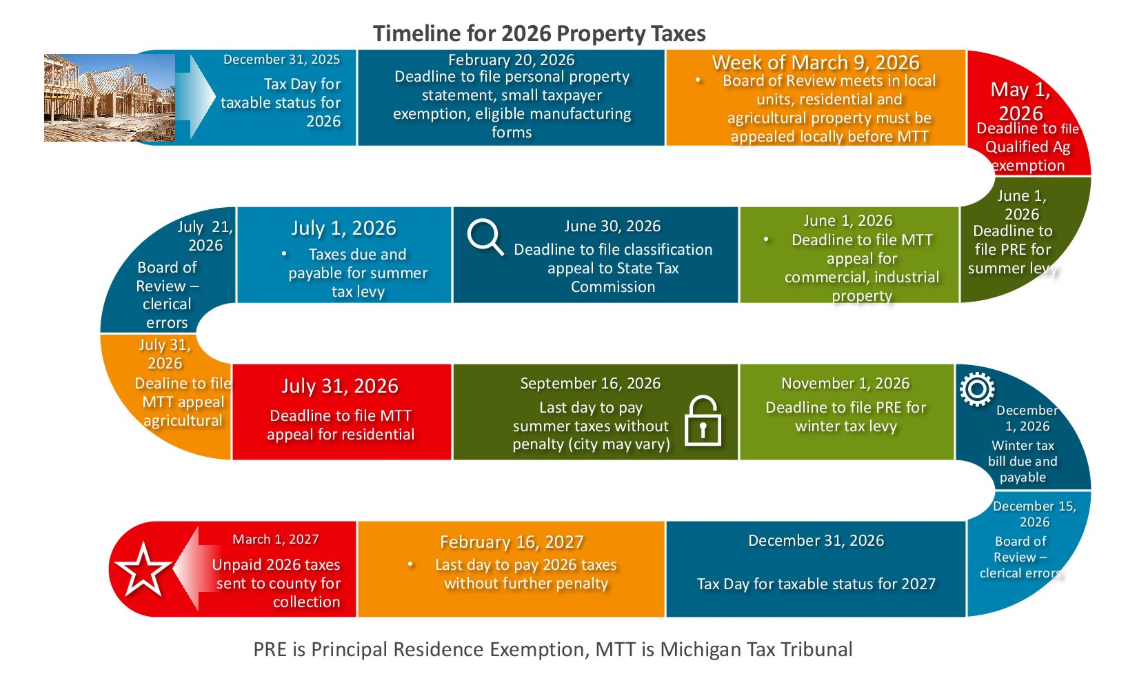
Timeline

February

Every year, near the end of February, an Assessment Notice will be sent to each real property and personal property owner in the City of Beaverton. On this notice will be:

  • The previous and current years assessed and taxable value
  • The dates and hours the March Board of Review meeting
  • The information about making an appeal

March

The Board of Review meets at 9am at Beaverton City Hall on the second Monday in March each year for the purpose of reviewing and correcting the assessment roll at Beaverton City Hall.

At this meeting, property value appeals and poverty exemptions are reviewed. More information can be found in the “How Do I” section above.

April

The review of assessments shall be completed on or before the first Monday in April. After the Board of Review shall complete the review of said roll, a majority of said Board shall endorse thereon and sign a statement on or before the first Monday in April to the effect that the same is the assessment roll of the City for ensuring the fiscal year, as approved by the Board of Review.

July

The July Board of Review meets at the Beaverton City Hall on the Wednesday following the third Monday in July each year. This meeting of the Board is convened by the Assessing officer to correct any clerical error or mutual mistake of fact.

At this meeting, poverty exemptions and principal residence exemption appeals (if the exemption was not on the roll) are reviewed. More information can be found in the “How Do I” section above.

Property value appeals are NOT heard at this meeting.

December

The December Board of Review meets at the Beaverton City Hall in December each year. Identical to the July Board of Review, this meeting of the Board is convened by the Assessing officer to correct any clerical error or mutual mistake of fact.

At this meeting, poverty exemptions are reviewed. More information can be found in the “How Do I” section above.

Property value appeals are NOT heard at this meeting.

City of Beaverton Logo

Beaverton is a vibrant community with a friendly small-town atmosphere; offering year-round events. Beaverton remains a walkable city with a strong sense of community that is seldom found in this busy world. Come share the beauty, charm and history of Beaverton.

Contact Us

Phone

989.435.3511

Email

Visit Us

128 Saginaw St., P.O. Box 477, Beaverton, MI 48612

City Hall Office Hours

Monday - Thursday: 7:00 am - 5:30 pm
Friday - Sunday: Closed